

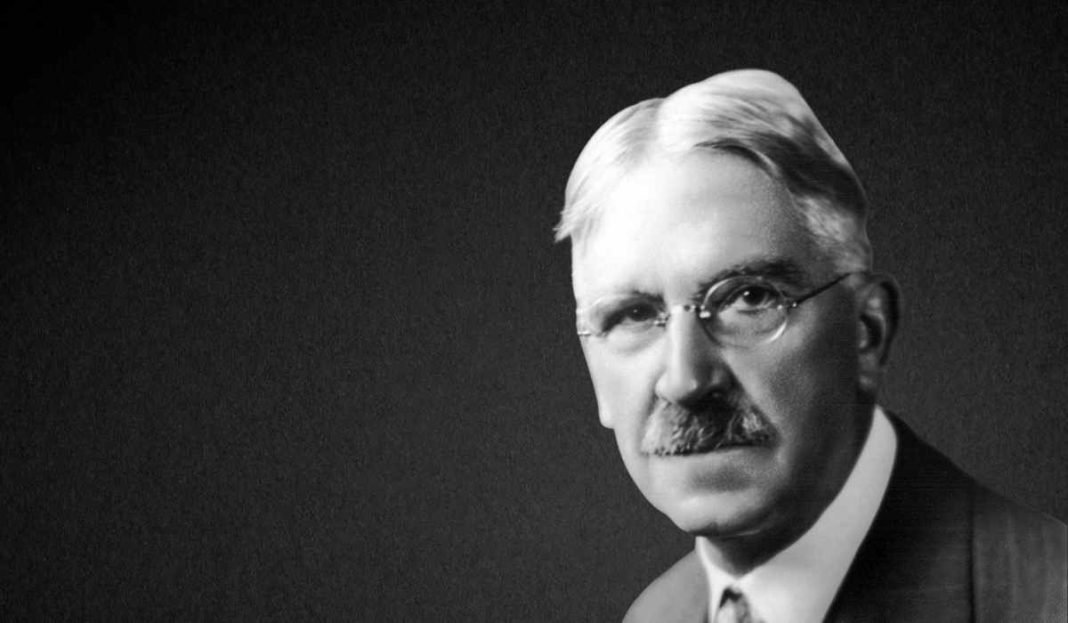

1. “Old ideas give way slowly; for they are more than abstract logical forms and categories. They are habits, predispositions, deeply ingrained attitudes of aversion and preference.” – John Dewey
2. “We always live at the time we live and not at some other time, and only by extracting at each present time the full meaning of each present experience are we prepared for doing the same thing in the future.” – John Dewey
3. “Traveling is a constant arriving, while arrival that precludes further traveling is most easily attained by going to sleep or dying.” – John Dewey
4. “The most important attitude that can be formed is that of desire to go on learning.” – John Dewey
5. “Skepticism: the mark and even the pose of the educated mind.” – John Dewey
6. “Criticism of the commitment of religion to the supernatural is thus positive in import.” – John Dewey
7. “The struggle for democracy has to be maintained on as many fronts as culture has aspects: political, economic, international, educational, scientific and artistic, religious.” – John Dewey
8. “It is obvious to any observer that in every western country the increase of importance of public schools has been at least coincident with the relaxation of older family ties.” – John Dewey
9. “Education is not preparation for life; education is life itself.” – John Dewey
10. “Everything which bars freedom and fullness of communication sets up barriers that divide human beings into sets and cliques, into antagonistic sects and factions, and thereby undermines the democratic way of life.” – John Dewey
11. “Purposeful action is thus the goal of all that is truly educative.” – John Dewey
12. “I believe that education is the fundamental method of social progress and reform.” – John Dewey
13. “It science involves an intelligent and persistent endeavor to revise current beliefs so as to weed out what is erroneous, to add to their accuracy, and, above all, to give them such shape that the dependencies of the various facts upon one another may be as obvious as possible.” – John Dewey
14. “There’s all the difference in the world between having something to say, and having to say something.” – John Dewey
15. “The central problem of an education based upon experience is to select the kind of present experience that live fruitfully and creatively in subsequent experiences.” – John Dewey
16. “I believe finally, that education must be conceived as a continuing reconstruction of experience; that the process and the goal of education are one and the same thing.” – John Dewey
17. “Teachers are the agents through which knowledge and skills are communicated and rules of conduct enforced.” – John Dewey
18. “When “reality” is sought for at large, it is without intellectual import; at most the term carries the connotation of an agreeableemotional state.” – John Dewey
19. “To me, faith means not worrying.” – John Dewey
20. “Confidence is directness and courage in meeting the facts of life.” – John Dewey
21. “Intelligence is in constant process of forming, and its retention requires constant alertness in observing consequences, an open-minded will to learn, and courage in readjustment.” – John Dewey
22. “Of all affairs, communication is the most wonderful.” – John Dewey
23. “Our historic imagination is at best slightly developed. We generalise and idealise the past egregiously. We set up little toys to stand as symbols for centuries and the complicated lives of countless individuals.” – John Dewey
24. “Knowledge falters when imagination clips its wings or fears to use them.” – John Dewey
25. “Teaching may be compared to selling commodities. No one can sell unless somebody buys.” – John Dewey
26. “We only think when we are confronted with problems.” – John Dewey
27. “The real process of education should be the process of learning to think through the application of real problems.” – John Dewey
28. “The outstanding problem of the Public is discovery and identification of itself.” – John Dewey
29. “Complete adaptation to environment means death. The essential point in all response is the desire to control environment.” – John Dewey
30. “Without some goals and some efforts to reach it, no man can live.” – John Dewey
31. “What the best and wisest parent wants for his own child, that that must community want for all it’s children.” – John Dewey
32. “Method means that arrangement of subject matter which makes it most effective in use. Never is method something outside of the material.” – John Dewey
33. “Every thinker puts some portion of an apparently stable world in peril.” – John Dewey
34. “The aim of education is growth: the aim of growth is more growth.” – John Dewey
35. “We can have facts without thinking but we cannot have thinking without facts.” – John Dewey
36. “Such happiness as life is capable of comes from the full participation of all our powers in the endeavor to wrest from each changing situation of experience its own full and unique meaning.” – John Dewey
37. “Everything depends on the quality of the experience which is had.” – John Dewey
38. “Legislation is a matter of more or less intelligent improvisation aiming at palliating conditions by means of patchwork policies.” – John Dewey
39. “Men’s fundamental attitudes toward the world are fixed by the scope and qualities of the activities in which they partake.” – John Dewey
40. “Failure is instructive. The person who really thinks learns quite as much from his failures as from his successes.” – John Dewey
41. “The plea for the predominance of learning to read in early school life because of the great importance attaching to literature seems to be a perversion.” – John Dewey
42. “It is difficult to connect general principles with such thoroughly concrete things as children.” – John Dewey
43. “The self is not something ready-made, but something in continuous formation through choice of action.” – John Dewey
44. “We have advanced far enough to say that democracy is a way of life. We have yet to realize that it is a way of personal life and one which provides a moral standard for personal conduct.” – John Dewey
45. “Popular psychology is a mass of cant, of slush and of superstition worthy of the most flourishing days of the medicine man.” – John Dewey
46. “The belief that all genuine education comes about through experience does not mean that all experiences are genuinely or equally educative.” – John Dewey
47. “When men think and believe in one set of symbols and act in ways which are contrary to their professed and conscious ideas, confusion and insincerity are bound to result.” – John Dewey
48. “To feel the meaning of what one is doing, and to rejoice in that meaning; to unite in one concurrent fact the unfolding of the inner life and the ordered development of material conditions – that is art.” – John Dewey
49. “You can teach students to develop the ability to think reflectively, and you can help them understand what this means, but if they are not inclined to do so they never will.” – John Dewey
50. “All learning begins when our comfortable ideas turn out to be inadequate.” – John Dewey
51. “Nature is the mother and the habitat of man, even if sometimes a stepmother and an unfriendly home.” – John Dewey
52. “Man lives in a world of surmise, of mystery, of uncertainties.” – John Dewey
53. “The best preparation for the future is a well-spent today.” – John Dewey
54. “The school must be “a genuine form of active community life, instead of a place set apart in which to learn lessons”.” – John Dewey
55. “Education as growth or maturity should be an ever-present process.” – John Dewey
56. “Independent self-reliant people would be a counterproductive anachronism in the collective society of the future where people will be defined by their associations.” – John Dewey
57. “The future of our civilisation depends upon the widening spread and deepening hold of the scientific habit of mind.” – John Dewey
58. “Thinking is the accurate and deliberate instituting of connections between what is done and its consequences.” – John Dewey
59. “One might as well say he has sold when no one has bought as to say he has taught when no one has learned.” – John Dewey
60. “If there is one conclusion to which human experience unmistakably points it is that democratic ends demand democratic methods for their realization.” – John Dewey
61. “Except in dealing with commonplaces and catch phrases one has to assimilate, imaginatively, something of another’s experience in order to tell him intelligently of one’s own experience.” – John Dewey
62. “Art is not the possession of the few who are recognized writers, painters, musicians; it is the authentic expression of any and all individuality.” – John Dewey
63. “Mind is a verb not a noun.” – John Dewey
64. “Every teacher should realize the dignity of his calling.” – John Dewey
65. “Giving and taking of orders modifies actions and results, but does not of itself effect a sharing of purposes, a communication of interests.” – John Dewey
66. “Inference is always an invasion of the unknown, a leap from the known.” – John Dewey
67. “Philosophy recovers itself when it ceases to be a device for dealing with the problems of philosophers and becomes a method, cultivated by philosophers, for dealing with the problems of men.” – John Dewey
68. “Some experiences are mis-educative. Any experience is mis-educative that has the effect of arresting or distorting the growth of further experience.” – John Dewey
69. “Art is the most effective mode of communications that exists.” – John Dewey
70. “Anyone who has begun to think places some portion of the world in jeopardy.” – John Dewey
71. “The good man is the man who, no matter how morally unworthy he has been, is moving to become better.” – John Dewey
72. “Time and memory are true artists; they remold reality nearer to the heart’s desire.” – John Dewey
73. “Not perfection as a final goal, but the ever-enduring process of perfecting, maturing, refining is the aim of living.” – John Dewey
74. “Democracy has to be born anew every generation, and education is its midwife.” – John Dewey
75. “Arriving at one goal is the starting point to another.” – John Dewey
76. “Only in education, never in the life of farmer, sailor, merchant, physician, or laboratory experimenter, does knowledge mean primarily a store of information aloof from doing.” – John Dewey
77. “Nature as a whole is a progressive realization of purpose strictly comparable to the realization of purpose in any single plant or animal.” – John Dewey
78. “Experience alone cannot deliver to us necessary truths; truths completely demonstrated by reason. Its conclusions are particular, not universal.” – John Dewey
79. “The path of least resistance and least trouble is a mental rut already made. It requires troublesome work to undertake the alternation of old beliefs.” – John Dewey
80. “One can think effectively only when one is willing to endure suspense and to undergo the trouble of searching.” – John Dewey
81. “The goal of education is to enable individuals to continue their education.” – John Dewey
82. “One lives with so many bad deeds on one’s conscience and some good intentions in one’s heart.” – John Dewey
83. “Now in many cases – too many cases – the activity of the immature human being is simply played upon to secure habits which are useful. He is trained like an animal rather than educated like a human being.” – John Dewey
84. “The interaction of knowledge and skills with experience is key to learning.” – John Dewey
85. “Education, therefore, is a process of living and not a preparation for future living.” – John Dewey
86. “If we learn not humility, we learn nothing.” – John Dewey
87. “Expertness of taste is at once the result and reward of constant exercise of thinking.” – John Dewey
88. “Just as a flower which seems beautiful and has color but no perfume, so are the fruitless words of the man who speaks them but does them not.” – John Dewey
89. “To “learn from experience” is to make a backward and forward connection between what we do to things and what we enjoy or suffer from things in consequence.” – John Dewey
90. “Who can reckon up the loss of moral power that arises from the constant impression that nothing is worth doing in itself, but only as a preparation for something else, which in turn is only a getting ready for some genuinely serious end beyond?” – John Dewey
91. “The end justifies the means only when the means used are such as actually bring about the desired and desirable end.” – John Dewey
92. “In brief, the function of knowledge is to make one experience freely available to other experiences.” – John Dewey
93. “A tribe, let us say, is warlike. The successes for which it strives, the achievements upon which it sets store, are connected with fighting and victory.” – John Dewey
94. “Holding the mind to a subject is like holding a ship to its course; it implies constant change of place combined with unity of direction.” – John Dewey
95. “Man is not logical and his intellectual history is a record of mental reserves and compromises. He hangs on to what he can in his old beliefs even when he is compelled to surrender their logical basis.” – John Dewey
96. “No system has ever as yet existed which did not in some form involve the exploitation of some human beings for the advantage of others.” – John Dewey
97. “Human nature exists and operates in an environment. And it is not ‘in’ that environment as coins are in a box, but as a plant is in the sunlight and soil.” – John Dewey
98. “Every great advance in science has issued from a new audacity of imagination. What are now working conceptions, employed as a matter of course because they have withstood the tests of experiment and have emerged triumphant, were once speculative hypotheses.” – John Dewey
99. “We do not learn from experience… we learn from reflecting on experience.” – John Dewey
100. “The origin of thinking is some perplexity, confusion or doubt.” – John Dewey
101. “No man’s credit is as good as his money.” – John Dewey
102. “The moment philosophy supposes it can find a final and comprehensive solution, it ceases to be inquiry and becomes either apologetics or propaganda.” – John Dewey
103. “The teacher loses the position of external boss or dictator but takes on that of leader of group activities.” – John Dewey
104. “Every serious-minded person knows that a large part of the effort required in moral discipline consists in the courage needed to acknowledge the unpleasant consequences of one’s past and present acts.” – John Dewey
105. “The deepest urge in human nature is the desire to feel important.” – John Dewey
106. “Education is not an affair of ‘telling’ and being told, but an active and constructive process.” – John Dewey
107. “To find out what one is fitted to do, and to secure an opportunity to do it, is the key to happiness.” – John Dewey
108. “Thinking and feeling that have to do with action in association with others is as much a social mode of behavior as is the most overt cooperative or hostile act.” – John Dewey
109. “Always make the other person feel important.” – John Dewey
110. “All genuine learning comes through experience.” – John Dewey
111. “I believe that in this way the teacher always is the prophet of the true God and the usherer in of the true kingdom of God.” – John Dewey
112. “Every great advance in science has issued from a new audacity of imagination.” – John Dewey
113. “Children who know how to think for themselves spoil the harmony of the collective society.” – John Dewey
114. “We rarely recognize the extent in which our conscious estimates of what is worth while and what is not, are due to standards of which we are not conscious at all. But in general it may be said that the things which we take for granted without inquiry or reflection are just the things which determine our conscious thinking and decide our conclusions.” – John Dewey
115. “Politics is the shadow cast on society by big business.” – John Dewey
116. “Balance is balancing.” – John Dewey
117. “I do not think that any thorough-going modification of college curriculum would be possible without a modification of the methods of instruction.” – John Dewey
118. “Were all instructors to realize that the quality of mental process, not the production of correct answers, is the measure of educative growth something hardly less than a revolution in teaching would be worked.” – John Dewey
119. “Education, therefore, is a process of living and not a preparation for future living. Without some goals and some efforts to reach it, no man can live. Education is not preparation for life; education is life itself.” – John Dewey